The Fellowship of the Ring
1. The Prophecy: version one - CD booklet Q.
2. The Prophecy: version two - Warner Bros. sheet music Q.
3. The Treason of Isengard: The Ring Poem B.S.
4. The Black Rider: The Revelation of the Ringwraiths A.
5. Flight to the Ford: Song to Tinúviel - Arwen's Theme S.
6. Many Meetings: A Elbereth Gilthoniel S.
7. The Council of Elrond: Aníron or Theme For Aragorn And Arwen S.
8. A Journey in the Dark: Durin's Song or Dwarves' Song I Kh.
9. The Bridge of Khazad-dûm: The Demon Comes or Dwarves' Song II Kh.
10. Lothlórien: Lament For Gandalf I - CD booklet S.
11. Lothlórien: Lament For Gandalf II - Warner Bros. sheet music S.
12. The Great River: Namárie Q.
13. Amon Hen: Departure of Boromir S. Q.
14. Amon Hen: The Seduction of the Ring Q.
15. May It Be Q.
16.
O Queen Beyond the Western Seas - FotR DVD
Extended Edition S. 
17.
Song to Tinúviel -
FotR DVD Extended Edition
S.
Version published in the CD booklet.
Lyrics by Philippa Boyens, music by Howard Shore, translated into Quenya by David Salo. This version differs from that one heard on the CD.). This version differs from that one heard on the CD.
Chorus in Quenya
Yénillor morne
tulinte i quettar
Tercáno Nuruva.
Hlasta! Quetis
Ilfirimain
'Out of the Black Years
come the words
[the] Herald of Death.
Listen! It speaks
to those who were not born to die...'
yénillor n. Ablative 'out of the (long) years'; cf. Q yén 'Elvish 'long year' of 144 solar years, 52,596 days'.
morne adj. pl. 'dark; black'; cf. sg. morna 'dark; black' (LR 373).
tulinte v. aorist 'they come'; tule 'come' + -nte 'they'; cf. tulin 'I come' (LR 395).
i quettar n. pl. 'the words'; cf. sg. quetta 'word' (S 436).
tercáno n. 'herald'; cf. tercáno 'herald' (PM:362).
nuruva n. Adjectival 'of death'; cf. nuru 'death' (LR 377).
hlasta v. imperative 'listen'; *hlasta- < CE slas-ta-, S-LAS- 'ear; hear'; cf. Sindarin lhaw 'ears'.
quetis v. aorist 'it speaks'; cf. quete 'say; speak' (S 436). [In the lyrics it reads erroneously quetes]
Ilfirimain n. pl. Dative 'to Immortals; to those who are not born to die'; it can be derived from il-firima-in 'im-mortal-to (pl.); cf. ilfirin 'LR 381' and fírimoin 'for Men' (LR 72). [In the lyrics it reads erroneously Hfirimain]

Version published in the Warner Brothers sheet music.
As above the text is based on the poem Malbeth the Seer's Words by J.R.R. Tolkien (in The Return of the King). Adaptation and lyrics by Philippa Boyens, music by Howard Shore, translated into Quenya by David Salo.
Chorus in Quenya
Hlasta!
Quetis Ilfirimain:
Corma
turien te
Corma tuvien
Corma tultien te
Huines se nutien.
Tercáno Nuruva.
Tuvien Corma tultien te
Huinesse nutien
Corma turien te Corma.
'Listen!
It
speaks to those who were not born to die:
[One] Ring to rule them [all]
[One] Ring to find [them]
[One] Ring to bring them [all]
[And] in the Darkness bind it
[The]
Herald of Death
to find [One] Ring, to bring them [all]
[And] in the Darkness bind it
[One] Ring to rule them [all], [One] Ring'
hlasta v. imperative 'listen'; *hlasta- < CE slas-ta-, S-LAS- 'ear; hear'; cf. Sindarin lhaw 'ears'.
quetis v. aorist 'it speaks'; cf. quete 'say; speak' (S 436). [In the lyrics it reads erroneously quetes]
Ilfirimain n. pl. Dative 'to Immortals; to those who are not born to die'; it can be derived from il-firima-in 'im-mortal-to (pl.); cf. ilfirin 'LR 381' and fírimoin 'for Men' (LR 72). [In the lyrics it reads erroneously Hfirimain]
corma n. 'ring; here: One Ring'.
turien v. gerund Dat. 'for ruling'; cf. tur- 'wield, control, govern', gerund *turie.
te pron. 'them'.
tuvien v. gerund Dat. 'for finding'; cf. *tuv- 'find', gerund *tuvie; cf. utúvienyes 'I have found it'.
tultien v. gerund Dat. 'for sending for; for bringing'; cf. tulta- 'send for, fetch, summon', gerund *tultie.
huinesse n. Locative 'in [the] darkness'; cf. huine 'deep shadow, gloom, darkness' + -sse Locative suffix.
nutien v. gerund Dat. 'for binding'; cf. nut- 'tie', gerund *nutien.
tercáno n. 'herald'; cf. tercáno 'herald' (PM:362).
nuruva n. 'of death'; cf. nuru 'death' (LR 377).
3. The Treason of Isengard: The Ring Poem
Featured in The Treason of Isengard. Lyrics by J.R.R. Tolkien and Philippa Boyens, translated into Black Speech by David Salo. Tolkien's text is bracketed below.
Chorus in Black Speech :
Shre nazg golugranu kilmi-nudu
Ombi kuzddurbagu gundum-ishi
Nugu gurunkilu bard gurutu
Ash Burz-Durbagu burzum-ishi [3:10-3:16]
Daghburz-ishi makha gulshu darulu. [2:55-3:09] [3:17, 3.21-3:29]
[Ash nazg durbatulûk, ash nazg gimbatul,
ash nazg thrakatulûk agh burzum-ishi krimpatul]
Daghburz-ishi makha gulshu darulu.
Gû kîbum kelkum-ishi, burzum-ishi. Akha - gûm-ishi ashi gurum.
Nubin sherkuk, rakhizinash, matizinashûk, matizin Umbrûk.
'Three rings for-Elven-kings under-sky
Seven for-dwarf-lords in-halls
Nine for-mortals doomed to-die
One for-Dark-Lord in-darkness
in-Mordor where shadows lie.
[One Ring to-rule-them-all, One Ring to-find-them,
One Ring to-bring-them-all and in-the-Darkness bind-them]
in-Mordor where shadows lie.'
'There-is-no life in-the-cold, in-the-dark. Here - in-the-void only death.
I-smell your-blood. I-shall-devour-it, eat-it-all - eat-all the-world.'
shre num. ‘three’.
nazg n. ‘ring’; evidently from Black Speech and taken from Valarin naškad, ‘ring?’.
nolug n. ‘Elf’; more specifically, this is an Orkish term for ‘Noldo’.
ran n. ‘king’; term may come from Elvish stem ÁR-AN, as in Sindarin aran, ‘king’.
-u prep. ‘for, to’; from the Orkish phrase Uglúk u bagronk sha pushdug Saruman-glob búbhoshum skai, one translation given being, ‘Uglúk, to the dungfilth, sha, the cesspool, the great Saruman-fool, skai’.
kilmi n. ‘sky’.
-nudu prep. ‘under’; probably related to the Elvish stem NU.
ombi num. ‘seven’.
khuzd n. ‘Dwarf’; no doubt from Khuzdûl khuzd, ‘dwarf’.
durbagu n. ‘ruler’; incorporating Black Speech durb-, ‘to rule’.
gun n. ‘stone’; may come from Elvish stem GOND.
dum n. ‘hall’; may be from Khuzdûl Khazad-dûm, ‘Dwarves-hall(s)’.
-ishi prep. ‘in’; from Black Speech burzum-ishi, ‘in [the] darkness’.
nugu num. ‘nine’.
gurunkil n. ‘mortals’; seems to incorporate Elvish stem ÑGUR1.
bard v. past ‘doomed’; probably from Elvish stem MBÁRAT.
gurutu v. inf. ‘to die’; may relate to Elvish stem ÑGUR1, could this also incorporate the ending –u, ‘for, to’?
ash num. ‘one’; from Black Speech ash nazg, ‘one ring’.
burz adj. ‘dark’; from Black Speech burzum, ‘darkness’.
burzum n. ‘darkness’; Black Speech term.
dagh n. ‘land’.
makha pron. ‘where’; cf. below: akha.
gulshu n. ‘shadows’.
darulu v. aorist ‘lie’.
gû adj. ‘no’; may be from the Elvish stem UGU.
kîbum n. ‘life’.
kelkum n. ‘coldness’; may be from Elvish stem KHEL-EK and Black Speech –um, ‘-ness’.
akha pron. ‘here’; related to makha above.
gûm n. ‘the Void’; incorporates Elvish stem KUM.
ashi adj. ‘only’; incorporating Black Speech ash, ‘one’, and a definite article –i?
gurum n. ‘death’; may be related to Elvish stem ÑGUR1.
nubin v. aorist ‘I smell’; with ending –in, ‘I’.
sherkuk n. ‘your blood’; may incorporate Elvish stem SEREK and ending –uk, ‘your’.
rakhizin v. future ‘I will devour’; with ending –izin, ‘I will’.
ash pron. ‘it’; using ash, ‘one’, as a noun?
matizin
v.
future
‘I
will eat’; from Elvish stem MAT and ending –izin, ‘I will’.
-ûk
suf.
‘all’;
seen in Black Speech durbatulûk, ‘to rule them all’.
Umbrûk n. ‘all the world’; from Elvish stem A-MBAR and ending –ûk, ‘all’.
4. The Black Rider: The Revelation of the Ringwraiths
Featured in The Black Rider, At the Sign of the Prancing Pony, A Knife in the Dark. Lyrics by Philippa Boyens, translated into Adûnaic by David Salo. Acknowledgments to Tarlancwen Luinil Derencar, Amanibhavam, Sshiskom and Petri Tikka for their help in finding the reasonable explanation of this fragment.
Chorus in Adûnaic:
Nêbâbîtham Magânanê
Nêtabdam dâurad
Nêpâm nêd abârat-aglar
îdô Nidir nênâkham
Bârî 'n Katharâd
'We deny our maker.
We cling to the darkness.
We grasp for ourselves power and glory.
Now we come, the Nine,
Lords of Eternal Life.'
nêbâbîtham v. pres. 'we deny'. This verbal form consists of: nê-bâbîtha-m 'we-deny-pl. marker'. The pronominal prefix *nê- 'we' is found in nênu 'on us' (SD 312). The verb *bâbîtha means 'deny, refuse'. It is probably derived from bâ 'negative particle' + bîtha 'said' < BITH (cf. unakkha 'he came' < NAKH; past tense is probably constructed by adding -a to the verb-stem). Compare Adûnaic *bâbîtha 'refuse' with Quenya váquet- 'refuse, say no'. The suffix -m is a verbal plural marker.
Magânanê n. 'our Creator'. The form *magân 'wright; maker; *creator' is found in Ar-Balkumagân 'King Ship-wright'. The suffix -(a)nê is probably the possessive form 'our' (see above *nê- 'we'). Is Magânanê 'our Creator' Eru Ilúvatar whom the Ringwraiths refused to serve?
nêtabdam v. pres. 'we cling'. For *nê- 'we' see above. The verbal form tabda 'touch' is found in kitabdahê 'touch me' (SD 250). The suffix -m is a verbal plural marker.
dâurad n. 'to [the] darkness'. Noun dâur 'gloom' is found in SD 424. The suffix -ad, -ada 'to, towards' is found in SD 429.
nêpâm v. pres. 'we grasp'. This verb is probably derived from the stem PA3 > pâ 'hand' (SD 416, 426).
nêd pron. 'for ourselves, lit. to us'. Cf. nê and -ad above.
abârat n. 'power and.... Cf. abâr 'strength, endurance, fidelity' (SD 431). The suffix -at is a dual marker (SD 428, 429, 430), but it is probably here a reconstructed conjuctive suffix.
aglar v. 'glory'. A loan-word from Sindarin aglar.
îdô adv. 'now' (SD 247, 312).
Nidir n. '[the] Nine'. Its etymology is unclear.
nênâkham v. pres. 'we come, we approach'; Cf. unakkha 'he came', form of NAKH (SD 247, 312).
Bârî n. 'the Lords' (SD 438).
'n Katharâd n. 'Eternal Life'. The etymology is unclear.
Note:
According to Danijel Legin's analysis this lyric is sung in the following songs:
THE SHADOW OF THE PAST
1:36 Nêbâbîtham magânanê
THE BLACK RIDER
1:05 Nêbâbîtham nêpâm nêd
1:40 Bârî 'n Katharâd
2:01 Nêbâbîtham magânanê
Bârî 'n îdô Nidir nêd aglar
AT THE SIGN OF THE PRANCING PONY
1:55 Bârî 'n Katharâd
Îdô Nidir
nênâkham nêpâm
abârat - aglar
A KNIFE IN THE DARK (~ represents partial words)
0:26 Bârî 'n Nidir nê~ (Bârî 'n Nidir nênâkham)
~dir nênâkham
Nêbâbîtham ma~ (Nêbâbîtham magânanê)
~gâna~ ~nanê
Nêtab~ dâur~ (Nêtabdam dâurad)
1:05 Nêbâbîtham ma~ (Nêbâbîtham magânanê Katharâd)
~gâna~ Katha~
Bârî 'n îdô nêd
FLIGHT TO THE FORD
2:31 Bârî 'n Katharâd
Îdô nêd nêpâm
Nêtabdam dâurad
Nidir nêpâm
Nêpâm nêd aglar
∙ Sindarin ∙
5.
Song to Tinúviel:
Arwen's Theme
Words by J.R.R. Tolkien, translated into Sindarin by David Salo.
Found also in the FotR DVD Extended Edition Appendices under "Music".
Here is full lyric.
Sindarin
Tinúviel elvanui [0.00-0.20]
Elleth alfirin [0.21-0.40]
'Tinúviel [the] elven-fair,
Immortal maiden'
Tinúviel n. 'nightingale, daughter of twilight' (name that Beren gave to Lúthien).
elvanui adj., n. 'elven-fair'; el- 'Elvish' + *vanui, lenited form of *banui 'fair, beautiful' (cf. BAN- in LR 351).
elleth n. fem. 'elf-maid' (WJ 363-4).
alfirin adj. 'immortal' (Letters 402).
6. A Elbereth Gilthoniel: featured in Many Meetings.
Lyrics by J.R.R. Tolkien, music by Howard Shore, performed by the choir.
Chorus in Sindarin
A Elbereth Gilthoniel,
silivren penna miriel
o menel aglar elenath,
na-chaered palan diriel
o galadhremmin ennorath
nef aear, sí aearon,
Fanluilos, le linnathon
Nef aear, sí aearon!
Sindarin text:
'O Elbereth Star-kindler,
(white) glittering slants-down sparkling-like-jewels
from firmament glory [of] the star-host,
to-remote-distance after-having-gazed
from tree-tangled middle-lands,
on-this-side [of] ocean, here [on this side of] the Great Ocean,
Fanuilos, to thee I will chant
on-this-side [of] ocean, here [on this side of] the Great Ocean!'
Detailed analysis can be found in Tolkien's books and in Ardalambion.
7. Aníron: Theme for Aragorn and Arwen.
Featured in The Council Of Elrond. Lyrics by Roma Ryan, composed and performed by Enya, translated into Sindarin by Roma Ryan (and David Salo?). See Elfling message no 16933.
Solo [by Enya] in Sindarin
O môr henion i dhû:
Ely siriar, êl síla.
Ai! Aníron Undómiel.
Tiro! Êl eria e môr.
I 'lîr en êl luitha 'úren.
Ai! Aníron...
'From darkness I understand the night:
dreams flow, a star shines.
Ah! I desire Evenstar.
Look! A star rises out of the darkness.
The song of the star enchants my heart.
Ah! I desire...'
o prep. 'from, of' (LR 360, WJ 366, etc).
môr n. 'darkness' (LR 373, Letters 382).
henion v. 'I understand'; cf. *henia- 'to understand' (LR 363) + -on '1st sg: I, me'.
i art. 'the' (LR 361, Letters 308).
dhû n. 'the night'; lenited form of dû 'nightfall, late evening, night' (LR 354).
ely n. 'dreams'; from Old Sindarin *olohi, Common Eldarin *olosi (cf. Quenya olori); cf. ôl, pl. elei ('mature' Sindarin *ely) 'dream' (LR 370, 379).
siriar v. '[they] flow'; cf. *siria- 'to flow' (LR 385).
êl n. 'star (archaic, used in verses)' (WJ 363, MR 373, RGEO 73).
síla v. '[it] shines white' (LB 354).
ai interj. 'ah' (LotR I: XII).
aníron v. 'I desire'; cf. aníra- 'to desire' (SD 129-31) + -on '1st sg: I, me'.
Undómiel Quenya name 'Evenstar, Star of the Evening'; Q undómë 'star-opening' + el 'star'.
tiro v. 'look!'; cf. tir- 'watch, gaze, look at' (LotR IV:X, RGEO 72).
eria v. '[it] rises'; cf. *eria- 'to rise' (LR 379).
e prep. 'forth, out'; cf. ed 'forth, out' (LR 356).
'lîr
n. 'the
song'; lenited form of glîr
'song, poem, lay' (LR 359).
en article
'of the (genitival article)' (Letters
308).
luitha n. '[it]
enchants'; cf. luita- 'to enchant' (LR 370).
'úren n. 'my
heart'; cf. lenited form of gûr 'heart (inner mind)' (VT 41) + -n
'my' (VT 41).
8. Durin's Song: featured in A Journey in the Dark
Featured in A Journey in the Dark. Lyrics by Philippa Boyens, translated into Neo-Khuzdûl by David Salo.
Choir in Khuzdûl
Durin ku binamrad
Ugmal sulu addad ku ba
Abad ku ganaga
Tur ganad
Abanul Durin
Ku bin Amrad
Ku ba kana a na aznan
Un du abad
Ku gan aga aznan.
The original poem by Ph. Boyens is:
'Durin who is Deathless
Eldest of all Fathers
Who awoke
To darkness
Beneath the mountain
Who walked alone
Through halls of stone
Durin who is Deathless
Lord of Khazad-dum
Who cleaved
The Dark
And broke
The silence
This is your light!
This is your word!
This is your glory!
The Dwarrowdelf of Khazad-dum!'
The choir score reads:
Durin Ku Binamrad
Durin Ku Binamrad
Ug-mal Sul-lu Ad-dad Ku Ba
Ab-ad Ku Gan-ag-a
Tur Gan-ad
A-ban-ul Durin
Ku Bin Am-rad
Ku Ba Ka-na A Na Az-nan
Un Du Ab-ad
Un Du Ab-ad
Ku Gan Ah-ga Az-na-n
9. The Demon Comes: The Dwarves' Song II
Featured in The Bridge of Khazad-dûm. Lyrics by Roma Ryan, translated into Sindarin by and David Salo. First published in the Muse magazine
Choir in Khuzdûl
Urus ni buzra!
Arrâs talbabi fillumâ!
Ugrûd tashniki kurdumâ!
Lu! Lu! Lu!
Urkhas tanakhi!
'Fire in the deep!
Flames lick our skin!
Fear rips our heart!
No! No! No!
The demon comes!'
From David Salo's commentary:
Some of the things you can see here are the construction of verbs with the prefix ta- (for third person): talbabi 'lick', tashniki 'rips', tanakhi 'comes'; the suffix -mâ for 'our': fillumâ 'our skin', kurdumâ 'our heart'. We have some related words, like urus 'fire', arrâs 'flame'; and some words that should look familiar, e.g. buzra 'deep' (cf. bizar 'valley, deep place' in Azanul-bizar), and urkhas 'demon, balrog', related to rukhs 'orc' much as Quenya rauco 'demon' is related to urco 'orc'. So there is real linguistic structure there, and an homage to Tolkien's languages; but very little of it is genuine Tolkien.
10. Lament for Gandalf: featured in Lothlórien.
Version published in the CD booklet.
Lyrics by Philippa Boyens, music by Howard Shore, translated into Sindarin by David Salo, performed by Elizabeth Fraser. This lyrics is different from the one performed on the CD. The whole text of the original English poem by Ph. Boyens was shown in the FotR DVD Extended Edition. It can be seen fully reconstructed here.
Verse 1
Quenya
A Olórin i yáresse
Mentaner i Númeherui
Tírien i Rómenóri,
Maiaron i oiosaila
Manan elye etevanne
Nórie i malanelye?
Verse 2 and 3
Sindarin
Mithrandir, Mithrandir! A Randir Vithren!
Ú-reniathach i amar galen
I reniad lín ne môr, nuithannen
In gwidh ristennin, i fae narchannen
I Lach Anor ed ardhon gwannen
Calad veleg, ethuiannen.
Quenya text:
'Olórin whom long ago
sent the Lords of the West
to guard the Lands of the East,
ever-wise of the Maiar
what drove you to leave [lit. 'why you left']
land which you loved?'
Sindarin text:
'Mithrandir, Mithrandir, O Pilgrim Grey
No more you will wander the world green
Your journey in darkness stopped
The bonds cut, the spirit broken
The Flame of Anor has left this World
Great light has gone out.'
Quenya
A Olórin n. Vocative 'O Olórin'.
i relative pron. 'who; whom'.
yáresse adv. 'once upon the time'.
mentaner v. pret. '[they] sent'; cf. menta- 'send, cause to go' (VT41:6).
i Númeherui n. pl. 'the Lords-of-the-West'.
tírien gerund Dative 'to guarding'; cf. tir- 'watch, watch over, guard, heed'.
i Rómenóri n. pl. 'the East-lands'.
Maiaron n. pl. Gen. 'of [the] Maiar'.
i oiosaila adj. 'ever-wise'.
manan pron. 'why'.
elye pron. 'you'.
etevanne v. pret. '[it] left'; cf. et-, ete- 'forth, out' and vanne 'went', pret. of vanya- 'go, depart, disappear.
nórie n. 'country'.
i relative pron. 'who; whom'.
malanelye v. pret. 'you loved'; cf. mel- 'love', pret. melane + -lye 'you'.
Sindarin
Mithrandir name 'Grey Pilgrim'; cf. mith '(pale) grey' + *randir 'wanderer, pilgrim' (see below).
a interj. 'O!' (Letters 308).
randir n. 'wanderer, pilgrim'; cf. Noldorin rhandir (LR 383).
vithren adj. 'grey'; lenited form of mithren (UT 436).
ú-reniathach v. 'you will not stray'; ú- negative prefix + renia- 'to stray' (LR 384) + -tha future tense marker + *-ch '2nd sg: you'.
i art. 'the' (LR 361, Letters 308).
amar n. 'the world' (LR 372).
galen adj. 'green'; lenited form of calen (LR 362, S 429, Letters 282).
reniad n. 'the journey'; < renia- (see above) + -ad gerundial suffix.
lín pron. 'your'; enclitic form of *lîn; cf. le 'to thee' (LotR II:I) and nín 'my' (UT 40).
ne prep. 'in; of'; reduced form of ned (SD 129-31).
môr n. (mór) 'darkness' (LR 373, Letters 382).
nuithannen pp. 'stopped'; cf. nuitha- 'to prevent from coming to completion, etc.' (WJ 413) + pp. marker.
in gwidh n. pl. 'the bonds'; cf. in 'the (pl.)' + *gwidh (pl. of gwedh 'bond'; LR 397).
ristennin pp. pl. 'cut'; cf. *ristannen, pl. *ristennin < *rista- 'to cut' (LR 384) + pp. marker.
fae n. 'spirit'; cf. Sindarin form of Fëanor: Faenor (PM 343).
narchannen pp. '*broken, rent'; cf. *narcha- 'to rend' (LR 374) + pp. marker.
lach n. '(leaping) flame' (S 433).
Anor n. 'Sun' (LR 348).
ed prep. 'forth, out'; cf. ed- 'forth, out' (LR 356).
ardhon n. 'world' (PM 348).
gwannen pp. 'left'; cf. gwanna- 'leave' (LR 397) + pp. marker.
calad n. (calad) 'light (LR 362, UT 65).
veleg adj. 'great, mighty'; lenited form of beleg (S 428).
ethuiannen pp. 'breathed out'; cf. thuia- 'breathe' (LR 393) + pp. marker.
Note:
Sheet music presents English text fragmentary translated into Quenya. We can therefore reconstruct the rest of the poem by Philippa Boyens, though there are some places which are very hard to decipher:
|
Solo text:
Olórin who once was... Sent by the Lords of the West To guard the Lands of the East, Wisest of all Maiar, What drove you to leave That which you loved?
No more will you wander The green fields of this earth Your journey has ended in darkness.
The bonds are sundered, The spirit is broken, The flame of Anor has left this World.
A great light has gone out.
Choir text:
Our love for this land Is deeper than the deeps Of the sea. Our regret is undying Yet we will cast all away Rather that submit. What should be shall be. |
Quenya and Sindarin translation:
Solo text:
A Olórin i yáresse Mentaner i Númeherui Tírien i Rómenóri, Maiaron i oiosaila Manan elye etevanne Nórie i malanelye?
Ú-reniathach i amar galen I reniad lín ne môr, nuithannen
In gwidh ristennin, i fae narchannen I Lach Anor ed ardhon gwannen
Calad veleg, ethuiannen.
Choir text:
Melme nóren sina núra ala Eäro nur Ilfirin nairelma ullume nucuvalme Nauva i nauva |
11. Lament for Gandalf: featured in Lothlórien.
Version published in the Warner Brothers sheet music.
Lyrics by Philippa Boyens, music by Howard Shore, translated into Sindarin by David Salo, performed by Elizabeth Fraser.
Solo
[by Elizabeth Fraser] in Sindarin
In gwidh ristennin,
i fae narchannen
I Lach Anor ed ardhon gwannen
Mithrandir, Mithrandir! A Randir Vithren!
Ú-reniathach i amar galen
I reniad lín ne môr, nuithannen
Chorus
in Quenya
Ilfirin
nairelma nauva i nauva
Ilfirin nairelma ar ullume nucuvalme
Nauva i nauva melme nóren sina nairelma
Sindarin text:
'The bonds cut,
the spirit broken
The Flame of Anor has left this World'
Mithrandir, Mithrandir, O Pilgrim Grey!
No more you will wander the world green
Your journey in darkness stopped.'
Quenya
text:
'Undying [is] our regret, [it] will be what will be [or 'What should be shall be']
Undying
[is] our regret and yet we will
cast all away,
[It] will be what will be, love for this land [is] our regret.'
The Quenya lyric is a translation of Galadriel's words in Tolkien's book:
'That what should be shall be,' she answered. 'The love of the Elves for their land and their works is deeper than the deeps of the Sea, and their regret is undying and cannot ever wholly be assuaged. Yet they will cast all away rather than submit to Sauron: for they know him now. For the fate of Lothlorien you are not answerable, but only for the doing of your own task. Yet I could wish, were it of any avail, that the One Ring had never been wrought, or had remained for ever lost.'
From "Fellowship of the Ring", Book 2, Chapter VII, The Mirror of Galadriel (found by 'a magpie'; see here)
Sindarin
in gwidh n. pl. 'the bonds'; cf. in 'the (pl.)' + *gwidh (pl. of gwedh 'bond'; LR 397).
ristennin pp. pl. 'cut'; cf. *ristannen, pl. *ristennin < *rista- 'to cut' (LR 384) + pp. marker.
fae n. 'spirit'; cf. Sindarin form of Fëanor: Faenor (PM 343).
narchannen pp. '*broken, rent'; cf. *narcha- 'to rend' (LR 374) + pp. marker.
lach n. '(leaping) flame' (S 433).
Anor n. 'Sun' (LR 348).
ed prep. 'forth, out'; cf. ed- 'forth, out' (LR 356).
ardhon n. 'world' (PM 348).
gwannen pp. 'left'; cf. gwanna- 'leave' (LR 397) + pp. marker.
Mithrandir name 'Grey Pilgrim'; cf. mith '(pale) grey' + *randir 'wanderer, pilgrim' (see below).
a interj. 'O!' (Letters 308).
randir n. 'wanderer, pilgrim'; cf. Noldorin rhandir (LR 383).
vithren adj. 'grey'; lenited form of mithren (UT 436).
ú-reniathach v. 'you will not stray'; ú- negative prefix + renia- 'to stray' (LR 384) + -tha future tense marker + *-ch '2nd sg: you'.
i art. 'the' (LR 361, Letters 308).
amar n. 'the world' (LR 372).
galen adj. 'green'; lenited form of calen (LR 362, S 429, Letters 282).
reniad n. 'the journey'; < renia- (see above) + -ad gerundial suffix.
lín pron. 'your'; enclitic form of *lîn; cf. le 'to thee' (LotR II:I) and nín 'my' (UT 40).
ne prep. 'in; of'; reduced form of ned (SD 129-31).
môr n. (mór) 'darkness' (LR 373, Letters 382).
nuithannen pp. 'stopped'; cf. nuitha- 'to prevent from coming to completion, etc.' (WJ 413) + pp. marker.
Quenya
ilfirin adj. 'undying; immortal'.
nairelma n. 'our lament; *our regret'; cf. naire 'lament' + -lma 'our'.
nauva v. fut. '[it] will be'.
i relative pron. 'what; who'.
ullume adv. 'not for ever; yet'; cf. ú- 'not' + lúme 'time'.
nucuvalme v. fut. 'we will cast all away'.
melme n. 'love'. [In the lyrics it reads erroneously melma]
nóren n. Dat. 'for land, country, people'; cf. nóre 'country, land, dwelling-place, region where certain people live, race, clan'. [In the lyrics it reads erroneously noren]
sina pron. 'this'.
12. Namárie: featured in The Great River.
Verse 1 is a fragment of the Galadriel's Lament (The Fellowship of the Ring book), verse 2 are Elendil's words when he came to Middle-earth after the Downfall of Númenor, repeated by Aragorn at his coronation (The Return of the King book). These Quenya lyrics are by J.R.R. Tolkien. Verse 1 is sung during the Fellowship's departure from Lórien, verse 2 during the passing of Argonath.
Verse 1
Chorus in Quenya
Ai! laurie lantar lassi súrinen,
yéni únotime ve ramar aldaron!
yéni ve linte...
'Alas! golden leaves fall in the wind,
long years numberless as [the] wings of trees!
Long years like swift...'
Verse 2
Chorus in Quenya
Et Eärello Endorenna utúlien.
Sinome maruvan ar Hildinyar tenn' Ambar-metta!
'Out of the Great Sea to Middle-earth I am come.
In this place I will abide, and my heirs, unto the ending of the world'
Detailed analysis can be found in Tolkien's books and in Ardalambion.
∙ Sindarin ∙
13.
Amon Hen:
Departure of Boromir
Words by J.R.R. Tolkien, translated into Sindarin and Quenya by David Salo.
As per directors commentary, this poem is included in the text when Boromir is slain. “We do not love the sword for its brightness,
Nor the arrow for its swiftness Nor the warrior for his glory We only love that which they defend.”
Sindarin
Ú-velin
i vegil an aegas [?]
egor i bilin a linnas
[?]
'I-do-not-love the sword for sharpness,
or the arrow for swiftness'
Quenya
... i
alda helda
[?]
i ehtelë lin(d)a.
[?]
Manna lelyalyë
[?]
Voromirë...
[?]
canelya ... (?)dessë si .... (?)mas
[?]
'... the tree naked
the spring beautiful.
Where-to you-go
Boromir...
your-valour... ?-in now ... ?
The choir score reads:
Eh-gawr Ee Bee-leen
Ah Leen-nahss
Oo-veh-leen Ee Veh-gheel
Ahn Ay-gahss
Eh-gawr Ee Bee-leen
Ah Leen
Ee Ahl-dah Hel-dah
Ee Ekh-tel-leh Lee-nah
Mahn-nah Lel-yahl-yeh
Vaw-raw-mee-reh
Kaah-nahl-yah Des-seh See Mahs
∙ Sindarin ∙
14.
Amon Hen:
The Seduction of the Ring
Words by J.R.R. Tolkien, translated into Sindarin by David Salo.
Found also in The Forbidden Pool in the TTT soundtrack
Quenya
i tuo...
i macil...
... (a?)staldaron...
marinyë... cor...
i tuo...
i macil...
a lelyat
túrenna...
i tuo...
'the strength...
the sword...
... of-the-valiant (?)...
I-live... ring (?)...
the strength...
the sword...
let they go (?)
to-victory...
the strength...'
The choir score reads:
Ee Too-aw
Ee Mah-keel
Stahl-dah rawn
Mow-ree Nye Kawr
Ee Too-aw
Ee Mah-keel
Ah Lel-yaht
Too-ren
Ee Too-ah
Lyrics by Roma Ryan, composed and performed by Enya, translated into Quenya by David Salo.
Solo [by Enya] in Quenya
Mornië utúlië
Mornië alantië
'Darkness has come'
'Darkness has fallen down'
mornië n. 'darkness'.
utúlië v. 'has come'; tul- 'come'.
alantië v. 'has fallen down'; lanta- 'fall down'.
16. O Queen Beyond the Western Seas
Lyrics by J.R.R. Tolkien (from The Fellowship of the Ring). Performed by David Long with Plan 9 (David Donaldson, Stephen Rocha, Janet Roddick.)
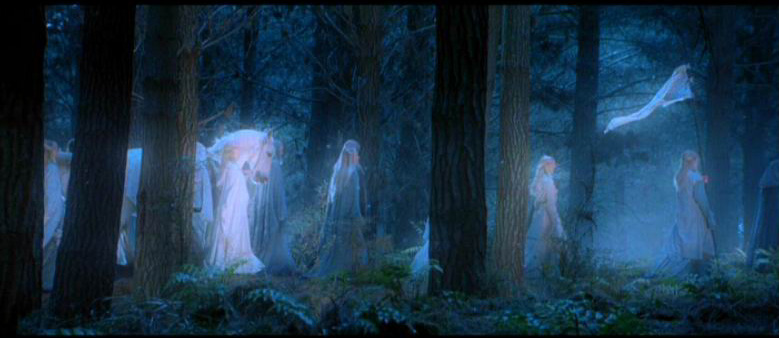
[Our friend, Frederick has found out that the song of the Elves is the literal Sindarin translation of Tolkien's poem Snow-white! Snow-white! from Chapter Three Is Company in The Fellowship of the Ring:
O
Light to us that wander here
Amid the world of woven trees!
Gilthoniel! O Elbereth!
Clear are thy eyes and bright thy breath!
Below there is the ultimate version of this lyric, sent to Taramiluiel by David Salo. See here.]
Solo [by Elizabeth Fraser?] in Sindarin
Sound file
[491 KB]
A Bereth thar Ennui Aeair!
Calad
ammen i reniar
Mi 'aladhremmin ennorath.
A Elbereth Gilthoniel
i chin a thûl lín
míriel...
'O Queen beyond the Western Seas!
O light to us that wander
Amid the tree-woven middle-lands.
O Elbereth Star-kindler
the eyes and breath your [are] shining-like-jewels...'
A interj. 'O!'.
Bereth n. 'queen'; cf. Sindarin Elbereth 'Queen of Stars'.
thar prep. 'beyond'.
Ennui Aeair n. 'Western Seas'; pl. of Annûn Aear 'Westen Sea'.
calad n. 'light'.
ammen pron. 'to us'.
i pron. 'who; that'.
reniar v. 'wander'; renia- 'to stray' (LR 384) + -r '3rd pl.: they’.
mi prep. 'in; amid'.
'aladhremmin adj. 'tree-woven', pl. of galadhremmen.
ennorath n. 'middle-earth'.
i art. 'the (pl.)'.
chin n. 'eyes'.
a conj. 'and'.
thûl n. 'breath' (LR 393).
lín pron. 'your'.
míriel v. 'shining like jewels'.
17. Song to Tinúviel: featured in Flight to the Ford and in Extended FotR on DVD
Lyrics by J.R.R. Tolkien, performed by Viggo Mortensen (Aragorn), translated into Sindarin by David Salo (?). Found in the FotR DVD Extended Edition Appendices under "Music". It's also sung in the beginning of Flight to the Ford.
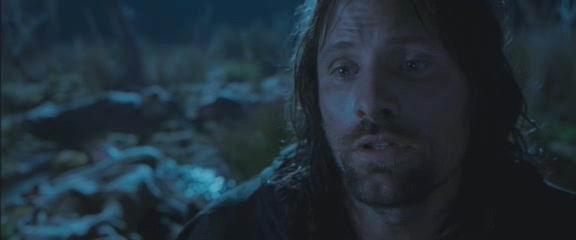
Aragorn singing Lay of Leithian

Song lyrics from the FotR DVD Extended Edition
Solo [by Viggo Mortensen] in Sindarin
Sound file
[245 KB]
Tinúviel elvanui
Elleth alfirin edhelhael
O hon ring finnil fuinui
A renc gelebrin thiliol...
'Tinúviel [the] elven-fair,
Immortal maiden elven-wise,
About him cast [her] night-dark hair,
And arms [like] silver glimmering...'
[compare this text with a fragment of Aragorn's song in the book by J.R.R. Tolkien (LotR, Book I, Chapter A Knife in the Dark):
Tinúviel the elven-fair,
Immortal maiden elven-wise,
About him cast her shadowy hair
And arms like silver glimmering...]
Tinúviel n. 'nightingale, daughter of twilight' (name that Beren gave to Lúthien).
elvanui adj., n. 'elven-fair'; el- 'Elvish' + *vanui, lenited form of *banui 'fair, beautiful' (cf. BAN- in LR 351).
elleth n. fem. 'elf-maid' (WJ 363-4).
alfirin adj. 'immortal' (Letters 402).
edhelhael adj., n. 'elven-wise'; edhel- 'elf' + hael, lenited form of *sael 'wise'.
o prep. 'about, concerning' (LR 378).
hon pron. 'he, him' (LR 385).
ring v. pret.. 'cast'; *rig- 'cast, wreathe (cf. RIG- 'twine, wreathe' in LR 383).
finnil n. pl. '(braided) hair'; sg. finnel (LR 387).
fuinui adj. 'nightly, dark'; cf. fuin 'night, gloom, darkness' (LR 354) + -ui 'adjectival suffix'.
a conj. 'and'.
renc n. pl. 'arms'; sg. ranc (LR 382).
gelebrin adj. pl. 'like silver'; sg. gelebren, lenited form of celebren 'like silver' (LR 365).
thiliol v. part. 'glistering, glimmering'; cf. thilia- 'glister' (LR 392).